
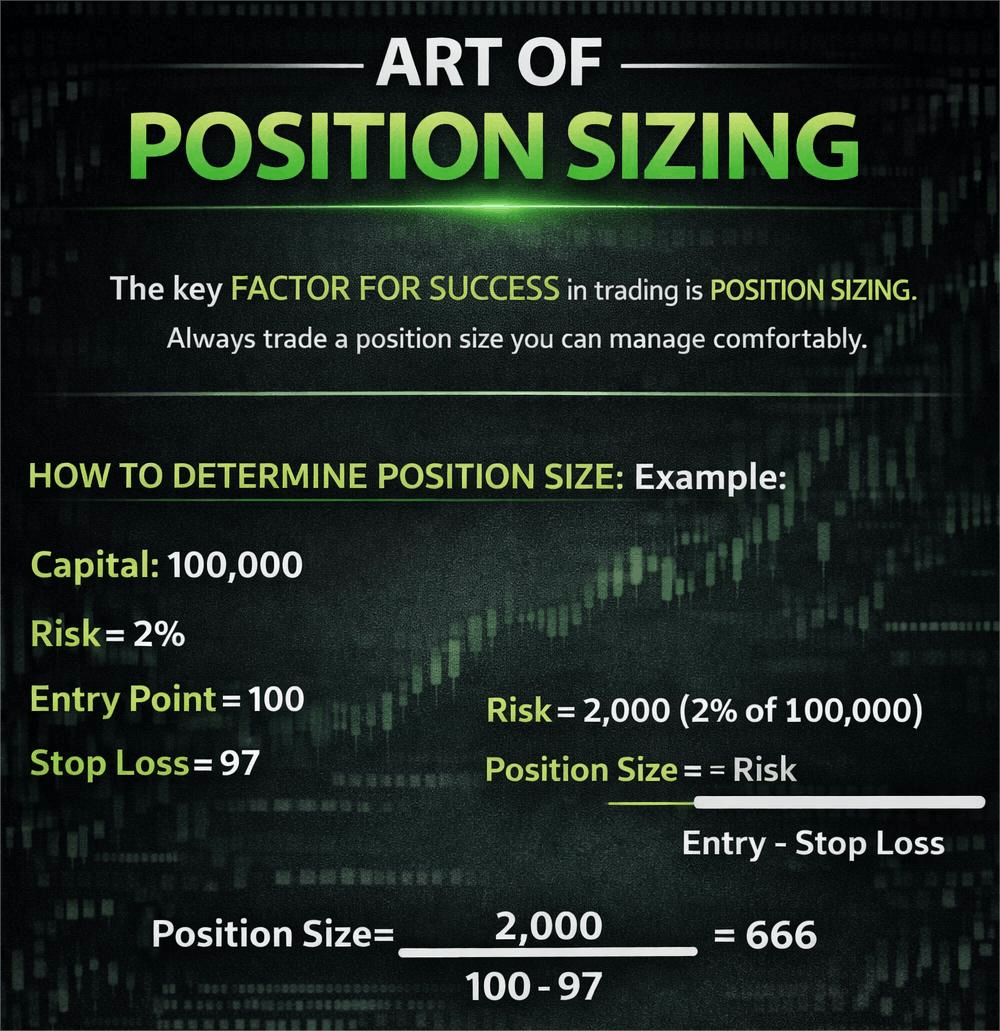
Position sizing refers to the process of determining how much capital to allocate to an individual trade or investment. Effective position sizing is a cornerstone of risk management, as it helps protect your trading account from significant losses. By limiting the amount committed to any single position, you avoid overexposure, preserve capital during losing streaks, and increase your ability to remain active in the markets over the long term.
Typically determine position sizes based solely on their available personal capital. A 1% return on a $10,000 account yields only $100 — making meaningful absolute returns difficult.
Manage substantially larger pools of funds. contributed by numerous participants. A 1% return on a $100M portfolio equates to $1 million in profit.
Professional investors frequently achieve higher consistency and success rates by participating in expert-led communities, pooled investment vehicles, or signal-based groups, where capital is aggregated and trades are executed collectively under experienced guidance. This approach can offer improved risk-adjusted performance compared to trading independently with limited resources.
If you’re interested in exploring structured, community-driven trading opportunities where funds are pooled with other investors and aligned with professional signals, feel free to reach out for details on our exclusive community.
The risk-reward ratio (often abbreviated as R:R or risk/reward) is a fundamental risk management tool in trading that compares the potential loss on a trade (risk) to the potential profit (reward). It quantifies how much you stand to gain for every unit of capital you’re willing to risk. A favorable ratio ensures that winning trades can outweigh losses over time, supporting long-term profitability even with a win rate below 100%.
If you risk $100 on a trade (distance from entry to stop-loss) and target $300 in profit (entry to take-profit), the ratio is 1:3. For every $1 risked, you aim to make $3.
A 1:3 ratio allows profitability with a win rate as low as 30–40%. Traders typically seek setups where reward significantly exceeds risk (1:2, 1:3, or higher) for positive expectancy.
A cornerstone of sound risk management is limiting risk per trade to 1–2% of total capital. This preserves the account during losing streaks and allows compounding over time. For instance, with a $50,000 account, risking 1% means no more than $500 at stake per trade.
If you’re looking to align with professional-level insights, access high-probability setups, and participate in trades positioned ahead of broader market trends through expert-guided signals and community collaboration, consider joining our exclusive community.
A stop-loss (SL) order is an automated instruction to close a trade at a predetermined price level when the market moves against your position, capping potential losses and protecting your capital. Conversely, a take-profit (TP) order automatically exits the trade once the price reaches your targeted profit level, securing gains before the market can reverse.
Safeguards survival during adverse moves. Automatically exits a losing position at a pre-set level, preventing catastrophic drawdowns and preserving capital for future opportunities.
Locks in rewards and prevents giving back hard-earned profits. Secures gains at your target level before the market has a chance to reverse.
Diversification involves allocating capital across a variety of assets, sectors, industries, geographies, or asset classes (e.g., stocks, bonds, commodities, forex, or alternatives) rather than concentrating in a single area. The core principle is to reduce unsystematic risk — the idea that poor performance in one holding can be offset by stronger results elsewhere.
A widely accepted rule among professional traders is to risk no more than 1–2% of total trading capital on any single trade. This conservative approach:
On a $50,000 account, a 1% risk limit means no more than $500 at stake per trade (calculated from entry to stop-loss distance, then determining position size accordingly). Many experts start beginners at 0.5–1% and allow slightly higher (up to 2–3%) only for high-conviction setups with proven edges.
Often emphasize technical analysis, chart patterns, indicators, and self-directed positioning — approaches that require years of practice, backtesting, and emotional discipline, often involving costly trial-and-error.
Leverage elite networks, professional insights, and timely information flows to position ahead of major trends or catalysts before they become widely publicized — delivering more consistent results.
If you’re interested in exploring community-driven opportunities where capital is pooled with other investors and aligned with professional signals positioned ahead of broader trends, feel free to reach out for details on our exclusive community!